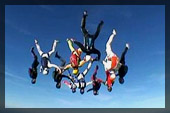
The South African Skydiving League is open to all current PASA SSA members and the jumps
may be performed
at any of the PASA dropzones.
During the SASL season there will be a freefly category for Open,
Intermediate and Novice freeflyers every month. Each month will consist of 3 rounds (2 Free Routines and
1 Compulsory).
For novice and intermediate each compulsory round will have 3 predefined moves,
whilst open will be the FAI compulsories which consist of 4 moves each. These
are detailed in this
document. There are 2 set compulsory rounds in each category. The draw will
alternate between them from month to month.
The free routine round consists of the team's own choreography of moves.
Teams may repeat the same routine every month or may change it as they choose.
The videographer shall be entered as a team member and will handicap the team's
performance in the same way as the performers do. The videographer is a
normal SASL competitor.
Although the SASL may be hosted at a dropzone each month, competitors are free to do the rounds at any dropzone at
any time during the month before the following month's draw has been announced. Competitors are free to attempt the draw as
many times as they wish before submitting their best rounds to the SASL website to be judged.
Each team will get an adjusted score (detailed in this document) which will then translate to individual competitor
league points. In the freefly event, each competitor in the team (including the camera flyer) will get the same number of
league points. Each month competitors' league points are added to their own total accumulated points and tracked on the
SASL website. At the end of the SASL season the winner will be the individual competitor who has the most league
points.
NOTE: The Freefly event of SASL 2011 will be completed at Nationals 2012.
Each participant in the league will be handicapped based on their experience (jumps and tunnel time). This may be
adjusted during the course of the league season. Your team's combined average handicap will be applied each month to
determine the team's weighted score for that competition. This allows for jumpers of any combination of experience
levels to compete equally.
Intermediate and novice draws are easier to accomplish for less experienced skydivers. You may enter open,
intermediate or novice each month but because your handicap acts as an equaliser they will be comparable with Open results. The reduced difficulty allows novice,
intermediate and open freefliers to compete and compare scores without the "double penalty" effect of a handicap and
harder jump for the intermediate and open competitors. Remember though - there are still separate novice,
intermediate and open leaderboards. This adjustment is only for individual league points allocation.
If 2 or more competitors are tied for league points the competitor with the
higher weighting will take the higher position.
- Teams are scored out of 10 on the technical execution of each move in the
compulsory sequence, and are awarded a presentation score for the transitions
between the moves.
- A team will score 0 for an omitted move.
- A team will score 0 for an incorrect move.
- Teams have 35 seconds of working time.
- There are 2 standard compulsory rounds. Each month, one of these will be
specified as the compulsory round for that month. Each compusory round's moves
may be performed in any order and linked together into a sequence as the teams
choose.
- Each competitor has a handicap based on their total jump numbers and
tunnel time. This is to give all competitors (open, intermediate and novice) a
fair chance of being the final SASL freefly winner. The handicap ratio
number for the freefly event is 120.
- Scoring for the freefly event works as follows:
- 1 hour of tunnel time is equated to 80 jumps
- Jumper A has 1000 jumps and 2 hours of tunnel . His total jumps
equates to 1160.
- Jumper B has 500 jumps and no tunnel time.
- Jumper C has 830 jumps and no tunnel time.
- They score 5.0 for round 1. Their adjusted score is calculated by
dividing the handicap ratio by the total jump numbers ( including
tunnel) for each jumper :
- Jumper A: 120 / 1160 = 0.103
- Jumper B: 120 / 500 = 0.24
- Jumper C: 120 / 830 = 0.145
- Then the handicap ratio for each jumper is applied to the score they
received for the round:
- Jumper A: (5.0 * 0.103) + 5 = 5.515
- Jumper B: (5.0 * 0.24) + 5 = 6.2
- Jumper C: (5.0 * 0.145) + 5 = 5.725
- Then the competitors adjusted scores are added together and divided
by 3:
- x(5.515 + 6.2 +5.725) / 3 = 5.813
- This adjusted score of 5.813 is the team's final score for that round.
- All 3 adjusted scores from the draw each month are added together to
determine the total.
- The three competitors from each team are then
assigned league points based on their overall standing against the
other teams for the month:
| Position | 1st | 2nd | 3rd | 4th | 5th |
League
Points | 5 | 4 | 3 | 2 | 1 |
- Each competitor carries their own league points through the season to
determine their final standing at the end of the SASL. Running totals are
kept up to date on the SASL website.
- By using this method, jumpers with 300 or 3000 jumps will all have an even chance of winning the SASL based on their experience level.
Every month the members of the top 5 placed teams in Freefly will be awarded league points for their
placing that month. The league points will be assigned as follows:
- 1st Place - 5 points
- 2nd Place - 4 points
- 3rd Place - 3 points
- 4th Place - 2 points
- 5th Place - 1 points
Any rules relating to the SASL that are not specifically covered in this document
will follow the rules outlined in the FAI Artistic Events documentation.
Any questions around these rules or the events themselves can be forwarded to the SASL committee.
The SASL reserves the right to amend these rules if deemed appropriate.
- Performers must have fewer than 200 freefly jumps each (ie: total non freefly jumps can be more than 200)
- No limitation on camera flyers jump numbers or skill level
- All team members must have at least CAT II in freefly
- Performers are not allowed to fly head down. Camera flyer may fly in any orientation
1. Flat Star
(Both performers are in a flat belly to earth orientation. The Performers demonstrate a two-handed, hand to hand grip with each performer's right hand in a grip with the other Performer's left hand.)
2. Flat Sidebody
(Both performers are in a flat belly to earth orientation. One performer takes a grip with one hand on the leg and the second hand on the arm of the other performer (Both grips must be taken on the same side ie: left hand to left arm and right hand to left leg. Or right hand to right arm and left hand to right leg.)
3. Dual 360 Turn
(Both performers are in a HeadUp orientation and setup facing each other. Both performers demonstrate a 360 degree turn (in either direction, around the vertical axis). Both performers must be in the camera frame at the same time during the turn. The performers do not have to begin their turns at the same time, but points are only awarded once both performers have completed their turns. An under or over rotation of up to 90 degrees is allowed.)
4. Dual Cartwheel
(Both performers are in a HeadUp orientation and setup facing each other. Both performers demonstrate a full cartwheel (in either direction) back to HeadUp. Both performers must be in the camera frame at the same time during the cartwheel. The performers do not have to begin their cartwheels at the same time, but points are only awarded once both performers have completed their cartwheels and are in a HeadUp position.)
5. Dual Forward Loop
(Both performers are in a HeadUp orientation and setup side by side, facing the same direction. Both performers demonstrate a full forward loop back to HeadUp. Both performers must be in the camera frame at the same time during the forward loop. The performers do not have to begin their forward loops at the same time, but points are only awarded once both performers have completed their loops and are in a HeadUp position.)
6. Headup Over/Under
(Both performers are in a HeadUp orientation and setup facing each other on level. The performers swap places by means of an over/under. One performer flies under with the other performer flying over. They then each turn 180 degrees to face each other ending off on level.)
- Performers must have less than 700 freefly jumps each (ie: total non freefly jumps can be more than 700). Neither of the performers
is allowed to have previously won intermediate freefly at nationals 3 times in total
- There is no limitation on camera flyers' jump numbers or skill level
- All team members must have at least CAT III in freefly
1. Double Foot to Knee Sit
(Both performers are in a HeadUp orientation. One performer demonstrates a double foot to knee dock on the other performer. The right foot of the top performer must be on the left knee of the bottom performer and the left foot of the top performer must be on the right knee of the bottom performer.)
2. Caterpillar
(Both performers are in flat belly to earth orientation. One Performer demonstrates a left hand grip on the left leg and right hand grip on the right leg of the other Performer.)
3. Single Foot-to-Foot
(Both performers are in a HeadUp orientation. The performers demonstrate a single foot to foot dock. Either foot of one performer touches either foot of the other performer.)
4. Single Hand-to-Foot
(Both performers are in a HeadUp orientation. One performer demonstrates a single hand grip on the other performer’s foot. Either hand of one performer takes a grip on either foot of the other performer.)
5. Dual Cartwheel
(Both performers are in a HeadUp orientation and setup facing each other. Both performers demonstrate a full cartwheel (in either direction) back to HeadUp. Both performers must be in the in the camera frame at the same time during the cartwheel. Performers must initiate their cartwheels within 2 seconds of each other.)
There will be no penalty for an over rotation or an under rotation of up to 44
degrees. An under rotation of 45 degrees or more will be awarded a zero.
6. Single Headdown to Headup Grip
(One performer is in a HeadUp orientation while the other is in a HeadDown orientation. The performers take a single hand grip.)
Please refer to the following document for more information on the Open compulsory moves:
FAI Artistic Rules